Thursday, June 23, 2011

Prairie

Visiting Illinois this past May and seeing a small piece of the Black Oak Savanna/prairie intact at Black Oaks, and then seeing certain prairie typologies recreated at the Chicago Botanical Garden generated a deep interest in these ecosystems for me. At the Botanic Garden I especially appreciated the care with which they explained ecosystems, recreation of the prairie, component parts of the systems - through thoughtful signs.  After living most of my life on the East Coast, amongst big trees and hills, seeing the sky and expanses of flat grasslands was beyond comprehension. Roaring through the landscape on the interstate did not abate my initial reaction of being overwhelmed by the wide open spaces (which, as a side note is a kind of  agoraphobia - something I only thought of a fear of places with lots of unfamiliar people in it - like an agora or marketplace...).

Only by getting out and walking in these spots was I able to focus and develop a more profound understanding and appreciation of these landscapes. There have been many studies about human affinity for the Savanna Landscape, given our evolutionary origins in Africa. Physically being in a Savanna, convinced me that those studies had some strong merits. While at Black Oaks, and along the edges of the prairie sections of the Botanic Garden, I felt a strong connection with the landscape and during the course at the Botanic Garden, I found myself thinking about walking through those prairies - because they are beautiful places and because I had never experienced the specific kind of tranquility I felt there. Perhaps it is all contextual, but I'd like to think there's something about these landscapes that I remember from my early childhood in Illinois.

Being in both places in May - when the grasslands are only beginning to come out of dormancy was beautiful. Striking golds, browns and earthy tones dominated the plant tones - with the exception of the base growth of the yarrows, shooting stars (dodecatheon meadia) and the golden alexanders (zizia aurea ( my new favorite plant name)). I had never seen shooting stars before, and I've included several photos of them below. They're stunning  fountains of blooms from elegant leaves.  Flocks of tree, cliff, and barn swallows animated the mornings and evenings that I passed through the prairies - and the trill of the red-wing black bird helped me keep time as I made my way back to the hotel each night.

Here at home, I am growing several of the characteristic species I observed at the Botanic Gardens. I started Compass Plant and Butterfly Milk Weed from seed and while they've taken a while to germinate and grow - they're doing well now that they're in the ground - and we're getting some heat. I am curious to see how they turn out. Taking the time to understand the life cycles of these component plants is part of the process I am following to restore part of the prairie at Black Oaks and to ensure that these plants and the ecosystems they support will continue to function and to benefit generations to come. 


Grasses


Black Bird on Compass Plant Stalk

Shooting Star

Shooting Star

Compass Plant Seedling Here

Thursday, June 16, 2011

Installation

Today is the first day I have not consulted on, hauled, planted, moved, seeded, mulched, composted or put together anything on the Terraces. It's truly the end of the first phase - the installation is finished for the season. 

All the plants are in - including the seedlings we started in April inside the house. There are over 30 varieties of vegetables, herbs, vines and trees that we planted in the space. Most of them - from the Hill Country Red okra, to the Schisandra vine are edibles or medicinal plants. It is satisfying to see the seedlings and the plants in the ground after so many years of dreaming, planning and designing. As the terraces mature over time, I look forward to new discoveries.

The day most of the plants were put in and the compost was spread, twenty to thirty yellow swallow-tail butterflies appeared. They moved from spot to spot where ever there was compost. It was amazing to see their progress across the terraces and field - moving to an internal jazz riff and then back together as if pulled by a steady bass line. Those butterflies were visual music to me. Music that makes me think of one of my favorite Georgia O'Keefe quotes: 

I want real things - music that makes holes in the sky. 

Happy Almost Summer everyone! 

Yellow Swallow Tails


Front View


Vegetable Beds

Vine Sculpture


Detail of Steel Bed Patina

Wednesday, June 8, 2011

Black Oaks

An hour and a half south of Chicago is the Black Oaks Center for Sustainable Living in Pembroke Township, Illinois. I met with Dr. Wright, one of the founders, walked the land with her and learned more about her vision for the site and the Center.

The vision as outlined on the Center’s website succinctly captures the essence of our conversation. We must weave a new way of life that is collective; cooperatively sharing and efficiently utilizing the resources we have; honoring the sacredness of life; working for the greater good of the whole.

Moving through the land with that mission in mind, especially after seeing the surrounding acres and acres of corn and soy and big box warehouses, was a true joy. Here is a soulful place with people dedicated to the restoration of the land and all levels of their community – from the molecular level, through soil health, to the big picture where people, plants and animals comprise a functional, resilient system.

The ecosystem context of Black Oaks is the Black Oak Savanna. That ecosystem is imperiled, according to the oaksavanna.org website. With intensive agriculture and housing development pressures, much of this biodiversity-rich ecosystem has been destroyed. Typical characteristics of the Black Oak savanna system are oaks and sun-loving plants that include many different types of grasses and herbaceous plants like compass plant that can tolerate temperature extremes and the excessively well drained soils of the Wisconsin Loess deposited by retreating glaciers. Making the site of the Black Oaks Center even more remarkable is that it is one of the remnant parts of this ecosystem, and to their credit, the people of the center are committed to its restoration. As part of the greater ecosystem restoration, medicinal plants and organic food will help support the people living at the center and the greater community they are part of.

I am enthusiastic and hopeful to bring my expertise in ecology, design and art to support the vision of the Black Oaks Center. Thanks to Dr. Wright for meeting with me and sharing her aspirations for such a marvelous place.

Exploring

Savanna


Black Oak
Savanna
 

Wednesday, May 18, 2011

Speaking Engagement

I'll be speaking at the Chesterfield council on aging next Monday the 23rd as part of their luncheon program that takes place at the Chesterfield senior center at noon time. My talk will begin after lunch. For information call 413.296.4007. 

I'll present an overview of healing gardens in the past, give some research findings on the therapeutic benefits of gardens and nature, and show some current examples of healing spaces including my own work. 

I've included some historical images I found compelling that will be part of my talk. 

Image Credits:
The Egyptian Gardener is from Earthly Paradises: Ancient Gardens in History and Archaeology, by Maureen Carroll

The Plant personification is from Enquete Sur Les Plantes Magiques, by Michele Bilimoff

Egyptian Gardener 


Plant Personification

Thursday, April 28, 2011

Spring Ephemerals

These plants may appear only briefly during the year, but their presence, like dear friends, reminds me of the sweetness of life and gives me a spontaneous joy upon seeing them. Especially after this long, snowy winter, the Hellebore, Trout Lillies, Marsh Marigold, Trillium, and Blood Root simultaneously blooming breathes new life and energy within me. There's a marvelous quality to each of these plants - as with any plant - but perhaps because of their timing, I am always grateful to see them again. 

Hellebore is one of my favorites. On my runs along the Potash Brook, Hellebore is one of the first glimpses of spring green to greet my eyes. There's an inspired vigor to the way its leaves muscle through the detritus of winter's floods and make their way skyward before summer's canopy becomes too dense. I find myself thinking of Hellebore when I have my own detritus to push through after an internal winter's flood....

The leaves are deeply sinused, ovate and large. To my eye, they abstractly resemble the waters of the streams they border - I've juxtaposed photos of the Hellebore and Potash Brook - only feet away from each other. This is the clearest illustration of something I've thought about often - how proxemic relationships might influence physical form, and internal modes of being. You can judge for yourself. 

Blood Root


Marsh Marigold

Trout Lilly


Hellebore
Trillium

Potash Brook

Monday, April 25, 2011

Raised Steel Beds

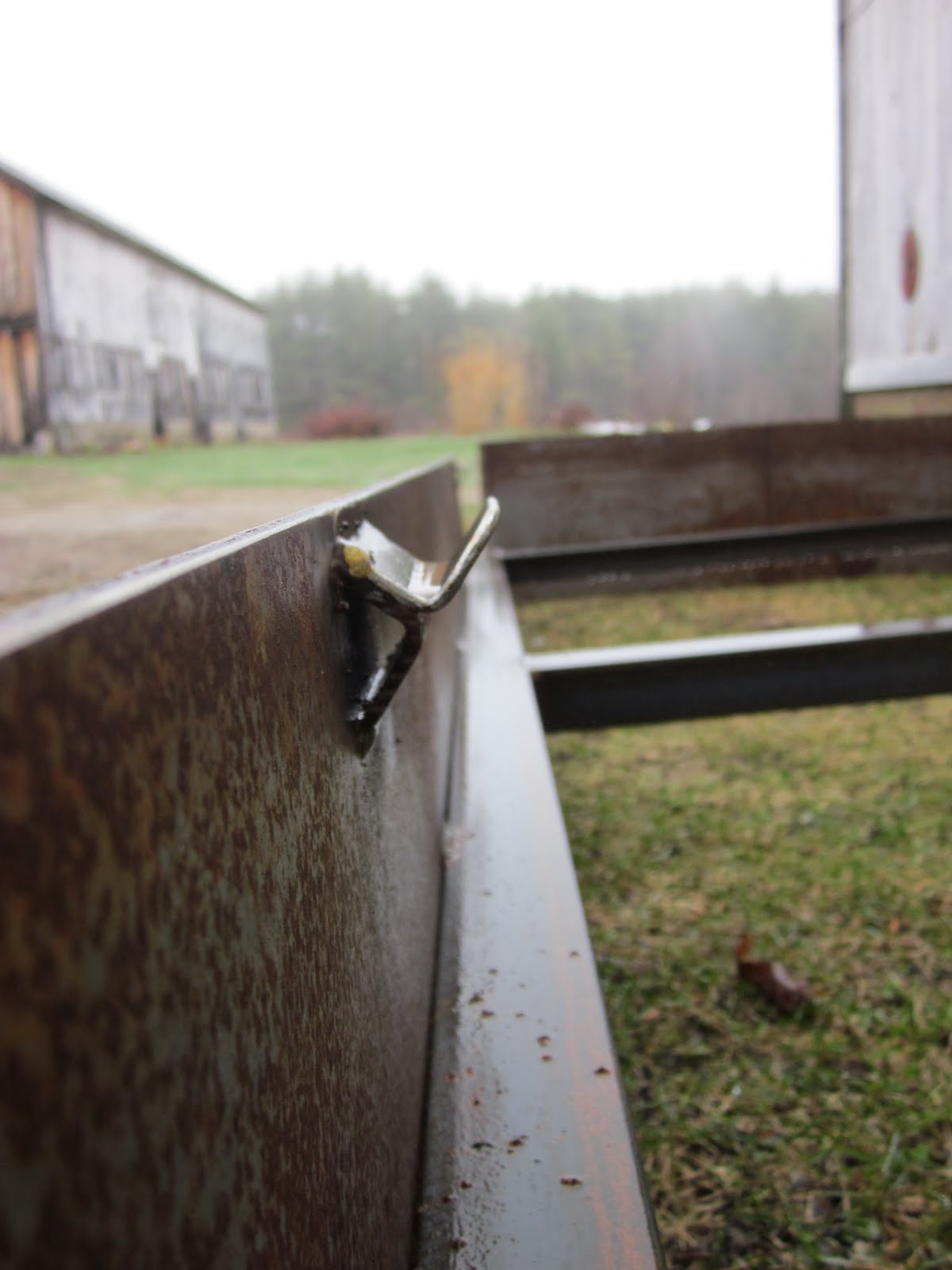
The raised steel beds have arrived. Bryan our metal/wood artist did a fantastic job with details like the hoop house attachments and the rounded edges.

The rusty red of the steel compliments the highlights in the Goshen stone. Rough stones in contact with smooth steel edges create compelling tension that will be made softer with time and plants. While I am eager for the growing season and for completion of the project, I appreciate the process involved with building the terraces and the steps involved. At this stage, you can see the internal frames of the beds, and the braces necessary to hold the steel in place - even without yards of loam, manure and compost adding pressure. There's poetry to seeing the internal components that are going to be buried soon - the beauty of a good frame that supports the function of the whole without the glamor of a spotlight. 


Wednesday, April 20, 2011

Twig fence

From my time working for the Smithsonian at the Sackler Gallery, the experience I reflect on most often, was watching the creation of a Tibetan Sand painting. Over the period of many days several monks created one of the most dynamic and beautiful works I have seen. Witnessing the process, the humility of the materials, the work's location and the monks changed my perspective on art, the creative process and the possibilities of art as a spiritual activity. The attention and sustained intent they lavished on making something so miraculous and sweeping it away has become a thread within my work and keeps me grounded from moment to moment, as I look for the most appropriate way to use the materials I have at hand for a project - as with the twig fence below that I just completed.