Monday, April 25, 2011

Raised Steel Beds

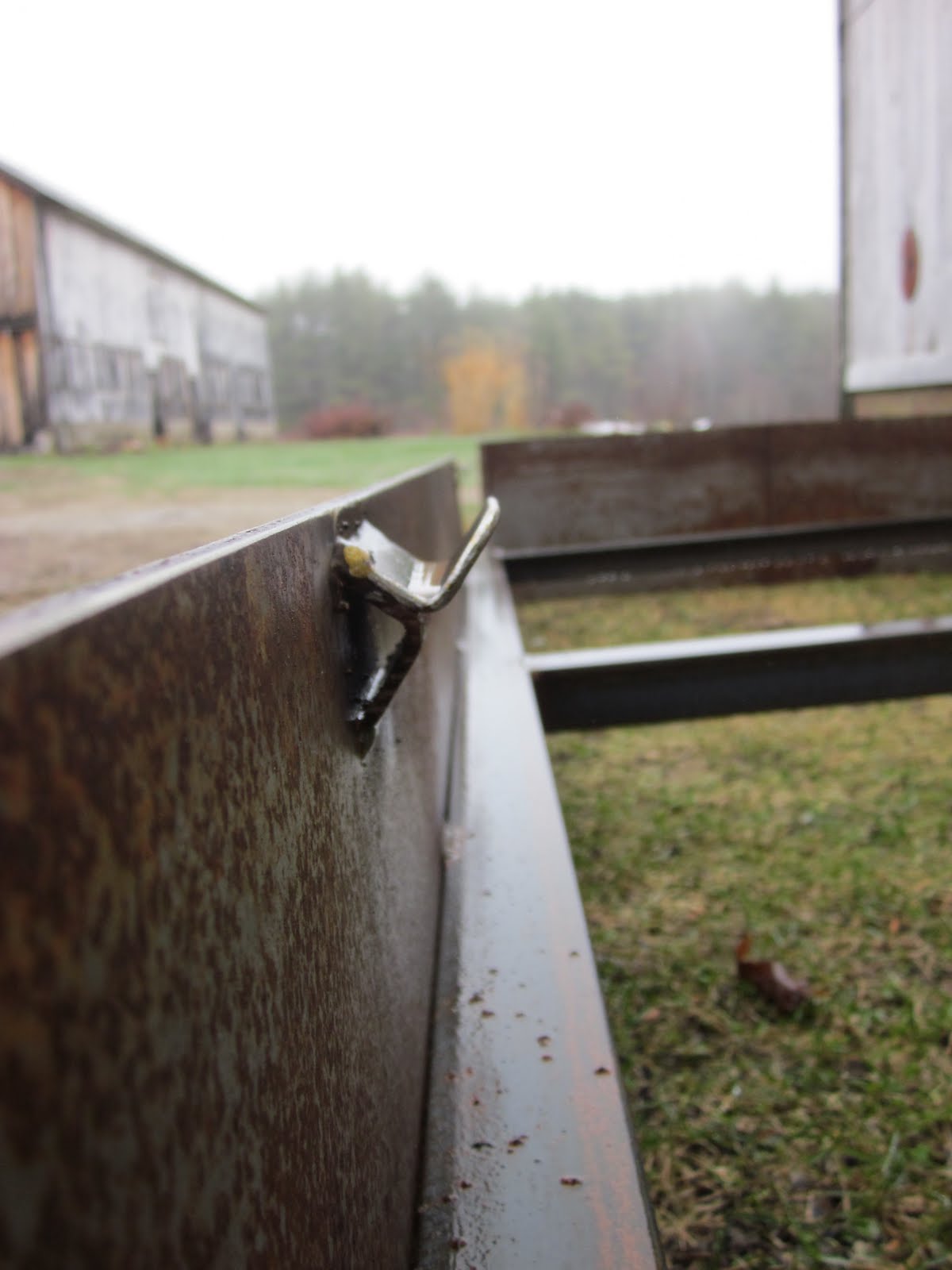
The raised steel beds have arrived. Bryan our metal/wood artist did a fantastic job with details like the hoop house attachments and the rounded edges.

The rusty red of the steel compliments the highlights in the Goshen stone. Rough stones in contact with smooth steel edges create compelling tension that will be made softer with time and plants. While I am eager for the growing season and for completion of the project, I appreciate the process involved with building the terraces and the steps involved. At this stage, you can see the internal frames of the beds, and the braces necessary to hold the steel in place - even without yards of loam, manure and compost adding pressure. There's poetry to seeing the internal components that are going to be buried soon - the beauty of a good frame that supports the function of the whole without the glamor of a spotlight. 


Wednesday, April 20, 2011

Twig fence

From my time working for the Smithsonian at the Sackler Gallery, the experience I reflect on most often, was watching the creation of a Tibetan Sand painting. Over the period of many days several monks created one of the most dynamic and beautiful works I have seen. Witnessing the process, the humility of the materials, the work's location and the monks changed my perspective on art, the creative process and the possibilities of art as a spiritual activity. The attention and sustained intent they lavished on making something so miraculous and sweeping it away has become a thread within my work and keeps me grounded from moment to moment, as I look for the most appropriate way to use the materials I have at hand for a project - as with the twig fence below that I just completed.


Monday, March 28, 2011

Solid and Fluid

Out walking this morning I arrived at the little stream I somehow always return to when I have no intended destination for my walk. There's a magic to this place and today was no different.


close up of stream
close up of stream 


These crystals overlaid on the stream were stunning. The combination of the angular ice and the protean stream beneath beautifully illustrates a sensual tension when two states of matter are in close proximity. It is the spaces where the light refracts from the motion of the stream between the angles of the crystals that compelled me initially to take these photographs.

There is poetry as well in the physical properties of water illustrated in the photos. When I think of water I always picture its fluid state - and seeing the contrast between the liquid and solid forms of water so clearly illustrated reminds me of the many layers of experience and perception that exist - if I am able to see beyond what I want to see. 


Monday, March 21, 2011

Spring planning

It is spring and most of the snow has melted off the terraces. It is amazing to see them revealed after several months of snow as you can see below. I've ordered all the vegetable and herb seeds as well as the fruit trees - so there'll be a massive transformation in the coming month or two. 

Here's a description of what is going to be happening with the next phase of the terraced garden:

The medicine and food growing terraces nestle into a south-east facing hillside. Stone walls, paths and steel raised beds will help retain heat and extend the growing season. Medicinal and culinary herbs at the lower level are closest to the kitchen – expediting harvest when cooking. These plants often have little appeal to deer and other browsers and it is hoped that their astringent taste would discourage any further exploration of the garden. The second terrace is the primary vegetable growing area with annual edibles, and an apricot tree planted near the former barn foundation wall. The third terrace hosts the berry canes and the gathering area. The tall wall behind the berry canes can secure netting to drape over the plants when berries are ripe and appealing to birds. The hillside provides a natural windbreak and a clear transition between intensely managed vegetable gardens and the minimally managed meadow beyond. Within this area, fruit and nut bearing trees and shrubs are interspersed with native plants to illustrate the diversity of plant life within an ecotone – or transition zone between ecosystems.

this winter with maximum snow

section of plantings in terrace garden

Tuesday, March 15, 2011

Renderings

I've been working with Dan Snow on a set of renderings for a stone maze he and the English Harbour Arts Council propose for a site in Newfoundland. It has been a joy to be part of this process - I can not wait to see this maze completed and become lost in its paths. It will be stunning. 


View from a hill
Entrance
Overhead
Tower and Sculpture


Image Credits

asartfoundation.org - Nancy Steinson Blue Sculpture

mistletoe.org.uk - Alexander Calder Sculpture

www.mermaidsofthelake.com - image of family picnic

Original maze design © Dave Phillips 
Other images courtesy of Dan Snow and Todd Lynch


Wednesday, February 23, 2011

Relationships

I have been working on a painting project over this past year. I am calling it Vegetable Portraits. Vegetable Portraits consists of nineteen small paintings and four soon-to-be large-scale paintings. Essays accompany the smaller paintings of vegetables, farms and farmers, and reflect the moment of the painting, the nature of the subject or the thoughts that the subject inspired within me. I have just completed two large-scale (4’ x 3’) renditions of two of the smaller paintings, and plan to create several more as part of the series. These large paintings further explore the color, space and compositional relationships initiated in the smaller pieces. 

Getting into the large-scale painting below of the Cukes, I began to see the relationships more clearly and how critical the transitions and so-called negative spaces are to the piece. Working big, it was easier to get lost in the painting - the movement, the color and defining the edges of the Cukes to create the spaces between. It's amazing that those spaces where "nothing" has been created become essential to the poetry of anything - paintings, landscape, dance. Some of the most eloquent thoughts on the importance of "betweeness" I've come across came from a New York Times book review on The View from Lazy Point, in which the author attempts to relay Carl Safina's views on the meaning of life. It makes me want to read the book.

...Safina asks us to reconsider the importance of that perennial question: “What is the meaning of life?” Which, he believes, is the wrong question to be asking because “it makes you look in the wrong places.” The right question is, “Where is the meaning in life.” And the place to look is “between.” In other words, we should look for the ways that all living creatures and all habitats are connected, look for what happens “between” them. “Relationships,” he insists, “are the music life makes. Context creates meaning.” 
By DOMINIQUE BROWNING Published: January 14, 2011

Perhaps that is some of the answer to my question in my last blog about how to choreograph transitions and create that sublime between.


Cukes - 10"x14"


Cukes - 3'x4'


Tuesday, February 8, 2011

Transitions

On the trip to Mexico I was able to look into my peripheral vision more often than I usually do when in my life at home. I wandered into familiar internal thoughtscapes of metamorphosis and found myself intensely aware of transitions - dawn, the sidewalk between the jungle and the road, the way a coconut connects to its stem and the pleasing wash-tub to rinse my feet from the beach when going into our palapa immediately come to mind. The novelty of those transitions got me thinking more about how metamorphosis might happen - fluid to solid to vapor - movement through membranes - thresholds - victory arches. When I was active doing outdoor installations in Baltimore with ice, that flux figured heavily in my work. 

What's different is that now I want to observe and experience the process of transition. There's a poetry to giving oneself to that flux and a danger of floating away - perhaps therein lies some of my curiosity in diagramming where and how materials/objects/spaces/planes of experience meet and intersect to create the living tapestry of each person's day. How does one choreograph seamless transitional elements in art and landscape installations to foster a deeper understanding of the self and how it relates to the world?  

sea fan

coconuts