Tuesday, May 22, 2012

Design fieldtrip

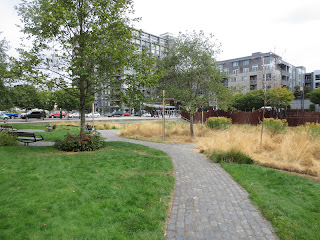
A few weeks ago, a good friend was passing through Boston, and I drove the 2 hours to see him. It was great catching up with said companiero over dim sum, but the best was ambling through the somewhat new Greenway together. Growing up I can remember the adventure of crossing under the Central Artery going to and fro from the North End, praying that the funky, stanky water dripping from above would not get on my red nylon Nikes, and that the freakishly large rats would not wrestle the cannoli from my hands. Thankfully, those anxieties were rarely realized. 

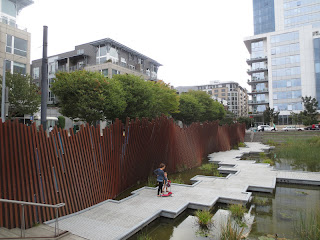
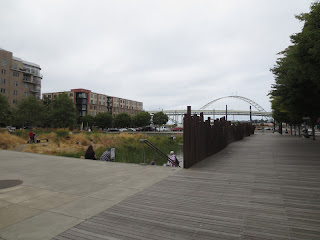
What is in place there now is a feat. Navigation of the permitting process alone is heroic and there are spaces that are truly memorable and evocative of place amongst the highrises of downtown - which make them all the more special. Standouts for me include the plantings in several areas - layers of native vegetation, but things not so common in the "palette" of landscape plant vernacular. I loved seeing Bugbanes, Tupelos and Virginia Sweet Spire interspersed with the more ubiquitous Inkberry and Arrowwood Viburnum.  The boldest move that I saw, but that sadly missed the mark was a passage filled with Dawn Redwoods - (Metasequoia glyptostroboides...one of my favorite Latin names...) and wild ginger and even some trout lily. All these plants were in poor shape and it raised a question for both my friend and I about the role of landscape dynamics - and how as designers working on contract or spec, in a fluid medium like plants, one can plan(t) for change. This entry is too small to explore this in any great detail but it's a great question and one that can prove confounding. Where there are specific criteria for buildings, roads and sewage systems, for a changing landscape and ecosystem dynamics there's more mutability ( yes there are criteria for landscape and ecological systems - but work with me for the sake of argument). For me, the controlled chaos within a garden or a landscape makes them alluring to me. I can attempt to maintain form, and some rhythm, but beyond that, I like to see what happens...Design for change is the idea, so that over time, as the landscape grows, you grow and evolve with it. That section of struggling woodland plants had no business in the baking sun where it was sited. Using an adaptive management strategy, those plants could have been cycled in when it was appropriate after some canopy had developed and some soils had been built over time - but I loose myself in design speak. 

It's beautiful. It's an improvement and what a gift to the Downtown. Bravo. 


hellobore in seed


stomwater basin


Tuesday, May 8, 2012

Spring salad

I am working on becoming a community herbalist. Ostensibly, that means that I can diagnose and treat people for baseline physical maladies - colds, coughs, respiratory and digestion challenges. My primary motivation for taking the course is to learn more in depth about the particular healing properties of each herb - what it treats, its growth pattern and which tradition it falls into - Ayurveda, Traditional Chinese Medicine (TCM), Western and Native American - foremost amongst all others. With that understanding, I can integrate those plants into landscapes that could help support people who have compromised health systems. I am doing that here at home and have designed for that with the community at Black Oaks.  An unexpected benefit has been learning an overview of the human health systems, their function and how much overlap there is between the micro-ecosystems within each person and the larger ecosystems around us in the world. Nested Ecologies - my underlying passion! 

The system we learned recently was the digestion system and ways to detoxify....It's that time of the year - when fresh greens - asparagus, nettles, lambs quarters and dandelions are appearing. All of these are great liver tonics, and help to produce bile to fire up the digestive process and clean and restore the body. Co-evolution at work....After one intensive session - all of us went out and harvested a "wild salad" to supplement our base of conventional lettuce, spinach and tatsoi greens. It's important to remember that the wild greens are best taken in smaller amounts because of their powerful digestive stimulant properties - I know this through my own experience. That said in moderation, there is something primally satisfying about foraging for food - especially something that has not been grown by you or anyone else. How many things do you consume everyday are truly "wild?" Eating wild is one way to truly ingest and digest the landscape around you - a practice that may bring (with moderation) a new perspective on what grows around you and what role the land plays in your life and the lives of your family and community. This time, one of my greatest revelations is how delicious trout lily leaves are. I never would have thought to eat them, but they are spicy like watercress, slimy like purslane and crunchy - besides the flavor - the mottled greens of the leaves are a delight....

I've also included a dressing recipe for making the greens more attractive to eat......thanks to my peers in the class...

Makes 3 Cups
2 Bunches cilantro/parsley
1/2 Cup Olive Oil
3 tsp Miso (white)
5 tsp Honey
6 TBLS Apple Cider Vinegar
2 Cloves Garlic
Pepper & Salt to taste
Zest of 2 lemons
6-7 TBLS Lemon Juice
1 "Bunch" assorted Spring Weeds - Chickweed, raw nettles, garlic greens, dandelion greens, dandelion flowers, catnip and chocolate mint
1 tsp Spirulina (optional)
 
fixins

dandelions

trout lily

burdock root


Wednesday, April 25, 2012

Trillium

Just over the hill, between the stream and embankment wall - I knew I'd find a trillium. I had a single purpose and focus. But sitting there, pencil in hand, my ears filled with the stream's voice. My eyes were seduced by joyous layering of textures and colors. My skin was warmed by the sun. The supple down of the unfurling red maple leaves tickled my ear every time the wind blew. Peripheral vision flooded in. It's spring now.

marsh marigold
Trillium
Indian Hellebore
Serviceberry

Thursday, April 5, 2012

James Hampton

Visionary Art. 
It's a funny term. It's far nicer than the french term for it - Art Brut. My heart holds a special place for Visionary Art  - because I grew up going to antiques auctions, where paint decorated furniture, weathervanes, and all manner of folk art were on view to look at and examine during the previews. Into my twenties, I grew to love the quirky, the funky, and the carnivalesque creations of artists like Wolfi, and Simon Rodia ( who created Watts Towers). I still love how soulful, expansive, and honest the work is. Nearly every visionary artist to me has a shamanic quality to their work, with the range and depth of the mythos that inspires their outflow. It's refreshing and at times startling to see that degree of raw connection to something that eludes or defies shared language. One artist I've been thinking about alot these days is James Hampton and his work - The Throne of the Third Heaven of the Nations' Millennium General Assembly.  There's a great back story here on the Colonial Williamsburg website: 


I got to spend a fair amount of time with the installation when I was interning at the American Museum of Art. No matter where I was that day while there, I always managed to be drawn to it. The pieces are beautiful, of humble materials but so imbued with meaning and intention that they hum with energy. Being there is quite an experience, and if you have the chance to go there I'd recommend it. Plus there's a great Burmese restaurant near by.....I think about not only the beauty of the piece and the intention behind it, but also the persistence of Hampton in creating it. He worked on it for more than a decade and it still was unfinished. To this day, experts have not deciphered the code in the volumes of notebooks he wrote explaining the mythos behind it. That's part of the magic of it for me. The focused intention of this man, turning foil into poetry motivated by an eternal calling. 

I think about Hampton and Rodia when I make stuff - especially when I do outdoor ephemeral art installations, or the thing I am working on in the barn. These creations are for me, for the joy of creation, to express my wonder with the materials and that I am here and have the chance to experiment one more day with them to see what comes and where that experimentation takes me.

James Hampton and the Throne  - image courtesy of Smithsonian

The Throne  - image courtesy of Smithsonian

Detail of  Throne  - image courtesy of Smithsonian


barn art

barn art

barn art

Thursday, March 29, 2012

Black Oaks

The planning phase for Black Oaks finished recently, and if all goes according to plan, the first phase will be installed in the late spring. It's exciting to think about what they're doing and that there's the possibility to see if ecological restoration and human health restoration are symbiotic. The research I've read and done on healing rates in hospitals and managed care settings clearly says that exposure to green spaces can reduce stress levels, heart rates, pain medications and increase healing times. Why can't those landscapes have plants or food that can be taken internally to boost those recovery rates? I believe when you give people a stake in the world around them, and create a motivation for them to get involved, then amazing results can occur. I am hopeful that at Black Oaks that will happen, and serve as a model for other communities. 

 I've included some images of what the proposed landscape might look like. 

Main Entrance

South Entrance

Forest Garden

Kitchen Garden

Friday, March 16, 2012

Work

I’ve been reading Shopcraft as Soulcraft by Matthew Crawford lately. It takes some time to digest. There are many great observations and ideas within it and I am often inspired to sit and think about what he has written when I am not trying to now fix things around the house as this book has inspired me to do. One line that really stands out for me follows a discourse in the chapter “To Master our Own Stuff” about advertisements that show people accessorizing objects with pre-made objects from the manufacturer – be they motorbikes or cake mixes where you “do it yourself” by adding an egg or oil to a mix. He says that “the marketers seem to grasp that it is not the product but the process that is really attractive.” If anyone is dialed into people, it’s marketing departments. Creepily so. For them to create the illusion of doing it yourself in their products there’s got to be something universally important about process and the fundamental satisfaction of mastering a skill that’s concrete – as so much of the way I know I live these days is controlled or obscured by others - ever try and jump start a Prius? This reclamation of process is made clear by the massive movements in raising food, making art and reviving artisanal industry and, I’d argue, the revolutions in the Arab World that are happening these days. Our vocabulary reflects this love of the small and involvement with the workings of our food, government and life – Authenticity, Local, Slow Food, Grassroots – these words/phrases are now so ubiquitous that their meanings are becoming hazy – as happened to “sustainable” and “organic.” As ever, I digress. I relate deeply to the importance of process – in my own art, design and life. This process piece and giving folks the tools to engage the world, when the traditional means for doing so have been dismantled, is a large part of my business/artistic vision. The projects I feel the deepest sense of connection to are those that all have underpinnings in empowering people to understand landscape process and dynamics. With that understanding they can then apply their own learning/artistic process within that ecological framework – through the plants they choose, how they adapt (to) the spaces, and how they work them into their everyday lives. It’s truly compelling to me to see how different people engage the world and to see the beauty that emerges when they do so collaboratively through a mastery of awareness and deliberate intention. 

The following photos are from some of my more ephemeral process pieces while I was living in Baltimore and show some of my early attempts to engage my ecological context. 

The Ice Faces are from a piece titled "Chance Mandalas" and were made from ice mixed with Lime powder to neutralize the acidity in a stream - for a short time - just behind John's Hopkins.

The maze in the photo is from me walking barefoot to create the pattern in the snow....


Wednesday, March 14, 2012

The Tarriance

Dan Snow wrote a few days ago to let me know the proposal we submitted for the stone and medicinal herb installation at the Central Oregon Community College was accepted! We'll be going to Bend, Oregon to install it in August.

Here is the text for the original proposal - written by Dan and me: 

My desire is to assemble a collection of unique stone
features, set amidst plantings of medicinal herbs and
flowers, to contrast the surrounding hardscape and compliment
the architectural elements of the building.

Two naturally smooth-contoured stones, 1-3 tons in size,
will rest on cribbing constructed of rough-split, quarried
stones. The sculptural features will seem to float above
plaza surfaces, and also interact with the existing stone
wall by coming into direct physical contact with it at
precise points. One of the natural stones, and many of
the quarried stones, will lend themselves to seating.
The constructed stone elements, within the total installation,
will have singular personalities of their own
owing to their one-of-a-kind characteristics. The linear
geometry and dynamic tension of the cribbing stones
will cradle the cool serenity of the boulders’ softly-worn
surfaces.

The Hardiness Zone 6 plants chosen for this installation
all have medicinal properties. The plantings are located
within areas already designated for a mix of 4” plugs
and plant seed mix in the plan set for the building. The
warm microclimate created by the site’s southwest exposure
and the profusion of stone surfaces to store thermal
gain will help to sustain the plants. Incorporating healing
plants into the walk-way extends the mission of the
science library beyond its walls and provides a reflective
metaphor for those passing by. As one ascends the steps
from the road to the library, the clinical uses of the
plants become more complex. At the level nearest the
road, are those plants most commonly used in folk medicine,
the middle level hosts plants that require a more
nuanced understanding for use, and those at the top are
the most powerful and demand a thorough comprehension
of use and manufacture.

The integration of plant with the stone evolves at each
terrace level, as though in concert with a student’s
rising knowledge and understanding. At the lower level,
low-growing plants like lavender, thyme and California poppy
flourish in the beds beside the terrace. In the middle, taller
plants like elecampane and baptisia embrace the cribbing/
stone. And on the top of the terraces, the installation will be
completely integrated with plants as passionflower and codonopsis
vines twist along the crib-rails and over the feature
stone. An environment of ephemeral plants and eternal rocks
is a living metaphor for finding ones path to a profound
understanding of healing. Education is a transformative
experience. New-found awareness and resulting change will
become a reoccurring theme expressed by the sculpture in
each moment and over the span of years.

Plants create a dynamic relationship with the rock through
seasonal change, motion and texture. Springtime and summer
will see foliage growing and blooming, creating a cushioned
topography and leafy backdrop. In autumn, the skeletal
remains of stalks and vines will cast a web of shadows. In
winter, the feature stones will be capped with snow and the
voids under them turned to soft, white hollows. The look and
feel of the piece will change with the seasons.

The sculpture will have an inviting presence, attracting the
viewer’s eye to explore its details of color, form and texture,
and at the same time, offer an overall sense of welcome to
those entering the building. The piece will offer surprises
upon first visit, something a little different with each repeated
viewing, and a feeling of grounded comfort to those
who pass by it every day.

Elements of the sculpture will present a variety of shapes
and sizes, creating compliments of scale within the piece
itself and with surrounding architectural features.
I see the building entrance area as a conduit for pedestrian
traffic, a meeting place, and an island of natural beauty. It’s
my hope that the plaza terraces, steps, walls, stone features
and plantings will merge and become one holistic, environmental
art experience.